
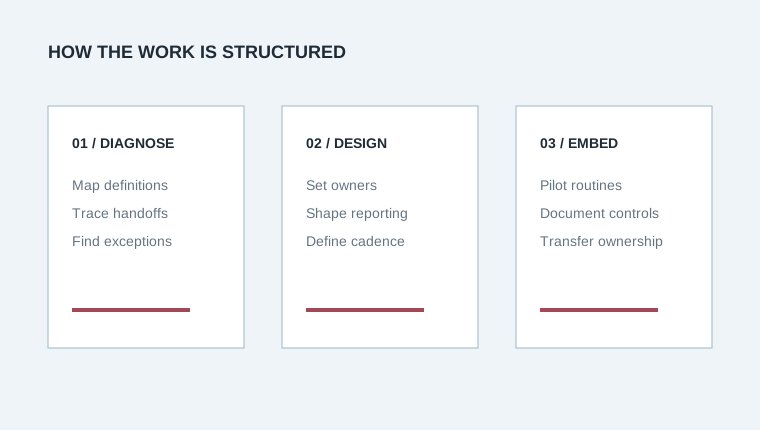
Diagnose. Design. Embed.
The goal is not a prettier spreadsheet. It is a reporting and finance-operations routine that people can actually repeat, explain, and own.
Trace what happens before the report appears.
Map definitions, source systems, handoffs, recurring reconciliations, exception points, owners, and the questions leaders ask after seeing the numbers.
- Interview the people who prepare and use the reporting.
- Separate data-quality issues from process-design issues.
- Identify where one-off work has quietly become recurring work.
Build the minimum useful operating layer.
Define the reporting package, operating definitions, exception thresholds, owners, cadence, and handoff rules that support the recurring decisions.
- Remove metrics that do not support a decision or explanation.
- Make definitions and ownership explicit.
- Document the expected path for exceptions.
Test the routine in real operating cycles.
Pilot the reporting cadence, observe where people still compensate manually, tighten the process, and transfer ownership with usable documentation.
- Run the process through actual recurring meetings.
- Capture failures while they are still cheap to fix.
- Leave the team with a routine it can own.
Clarity beats ornamental complexity.
Start with the decision or recurring problem before choosing a metric or artifact.
Recurring work should have an explicit owner, handoff, and escalation path.
The process should surface what changed, why, and what happens next.