
Six-week live-style workshop
Make your offer easy to understand.
You do not need more services, more jargon, or a louder sales page. You need a buyer to understand what you do, who it is for, and why the next step makes sense.
The problem
Expertise can still be hard to buy.
You may know exactly how to do the work. The buyer still has to make sense of the offer before they can say yes.
- דI do a lot of different things.”
The buyer has to assemble the service in their head. - דIt depends on what they need.”
Flexibility becomes vagueness before the conversation even starts. - דPeople like it once I explain it.”
The website should not require you to personally translate it every time.
The clarity method
Three questions. In the right order.
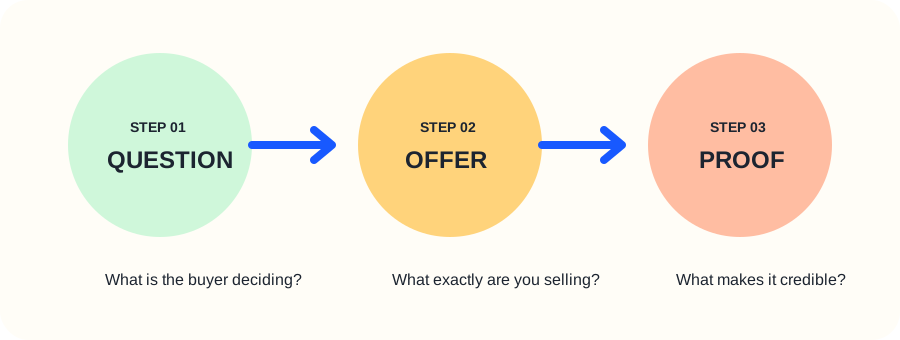
The workshop moves from buyer decision → offer boundary → proof. That keeps the copy rooted in what a real person needs to decide.
Work through it
See what changes at each step.
Start with the decision, not the headline.
Before writing copy, name what the buyer is trying to decide. “Do I need this?” “Is this built for a business like mine?” “What exactly happens after I say yes?”
- Choose one primary buyer
- Name the decision they are making
- Separate real objections from copy clutter
Put a useful boundary around the work.
Clarity does not mean making every service identical. It means the buyer can see the starting point, the scope, and the outcome without decoding a list of capabilities.
- Define what is included
- Show where customization begins
- Use plain nouns and verbs
Answer “why should I believe this?”
Proof is not a wall of badges. It is the concrete detail that lowers uncertainty: process, examples, boundaries, samples, and what happens next.
- Match proof to the claim
- Show the process where useful
- Remove unsupported superlatives
Curriculum
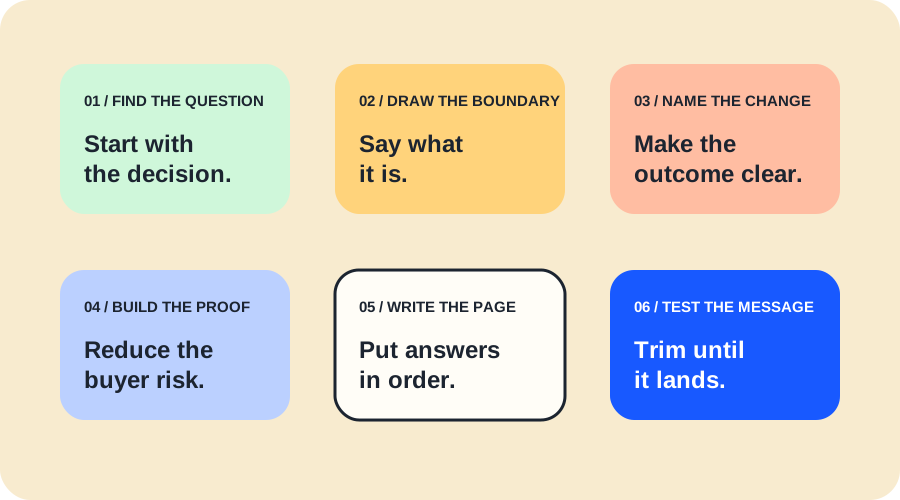
Six modules. One usable offer.
Each week solves a specific clarity problem. By the end, you are not holding a pile of prompts—you have a structured offer page and the reasoning behind it.

Your instructor
Jordan Vale teaches by taking things apart.
Not to make them complicated—to find the sentence that is carrying too much weight, the service list that has no priority, or the proof that answers the wrong question.
Ready to see the full program?
Make the work easier to choose.
See the six-week format, what you build, and what the workshop is—and is not—for.