
Six modules
Every week removes one kind of confusion.
The curriculum starts before copywriting. First define the buyer decision. Then define the offer. Only then do we shape the page.
What the sequence protects you from.
Most unclear pages are not really copy problems. They are decision problems: too many buyers, no boundary around the service, unsupported promises, or sections that do not answer anything useful.
Course rule: If the message is fuzzy because the offer itself is fuzzy, rewrite the offer before rewriting the headline.
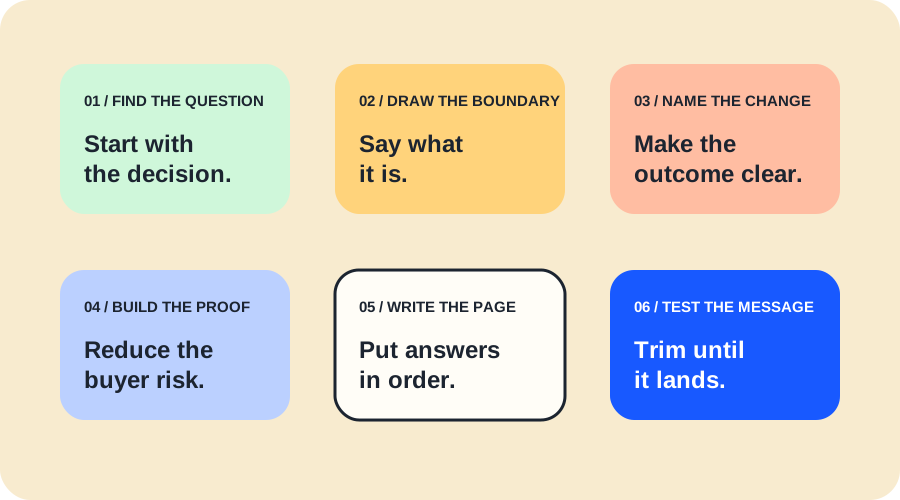
Choose the primary buyer and identify the decision they are actually trying to make. Separate “interesting information” from information that changes the decision.
Define the core offer, the options, and the point where custom work begins. The goal is not rigidity. It is visible structure.
Describe the practical change the buyer is paying for without inflating it into a life-changing claim. Use observable outcomes and useful boundaries.
Match proof to risk. Process details can prove control. Samples can prove craft. Boundaries can prove judgment. Not every claim needs a testimonial.
Arrange the answers in the order a buyer needs them: what it is, why it matters, what happens, what is included, why it is credible, and what to do next.
Use a final confusion audit. Test whether a new reader can identify the offer, buyer, outcome, process, boundary, price direction, and next step without a live explanation.
Next
See why the sequence works.
The method page explains the reasoning behind question → offer → proof.